

Soldiers Shot by Native Arrows, on the Don Tristán de Luna 1559 Expedition to la Florida Part 1 of 4
by
David B. Dodson
September, 2025
Wounded Soldiers, Supplication for Mercedes (Rewards), and The Native Bow and Arrow
Introduction
When one reads the main, written accounts of the Luna Expedition of 1559 there is little recognition of the Natives of the American Southeast shooting arrows, wounding soldiers, nor killing of people that went on the expedition. This would lead one to believe that the Luna expedition was somewhat of a peaceful venture as ordered by the Spanish Crown without any notable confrontation or skirmishes with the Native populations; and it is not that the modern authors deliberately edited or censured such actions by the Natives. It’s just that the documents compiled while the two-year expedition was underway–especially those written by Viceroy Luis de Velasco of New Spain who developed and implemented the expedition–just don’t mention bow and arrow attacks by the Natives. But a deeper search into the archival records of post-expedition documents inform that this was not the case; there were many attacks, and deadly ones, too. Why were these attacks not mentioned?
This history will bring to light some of the many “hidden” hostile bow and arrow confrontations between the Spanish and the Native populations, and identify some of the victims and their lives, as well as their supplications for rewards (called mercedes[1]) from the Crown for being loyal and worthy servants.
But to accommodate the many challenges of putting a long history on the web site, the presentation will be divided into Four Parts: Part 1 will discuss background information, how one asked for mercedes, and present information about the Native bow and arrow; Part 2 will present two accounts of soldiers being attacked by the Natives, and what mercedes—if any—they were granted; Part 3 will present two more accounts of Native attacks; and Part 4 will address the apparent suppressing of knowledge of such Native hostilities and attacks in official correspondence and documents while the expedition was underway; and it will become evident that although it was an unwritten policy, it was a deliberate effort in “omission” for political reasons by Viceroy Luis de Velasco in order to try to keep the expedition moving forward on behalf of the Spanish Crown. Further, it will be shown that the soldiers and colonists while in la Florida also censured their speech and reports of the hostile natives, and like Viceroy Velasco, suppressed knowledge of attacks, wounds, and even deaths by Native arrows–but in their own self-interests–out of fear of both political and religious repercussions.
Background Information
In the chronicles concerning the Hernando de Soto expedition of the 1540’s to the American Southeast there are numerous accounts of soldiers getting shot by Native American arrows throughout the extensive entrada, and especially at the big battle of Mauvila. That Spanish-Native confrontation took place on the Lower Alabama River not too far from where the Don Tristán de Luna Expedition later established an inland settlement at the Native town of Nanipacana in early 1560. Thousands of Natives were killed or wounded, and of the six hundred Spanish soldiers involved, some were killed and practically everyone suffered wounds, especially from Native arrows.[2] Memories of the battle and the Native mistake of direct confrontation with the Spanish and their horses were not forgotten by the Natives of the area. Hence, there are only a few mentions in The Luna Papers of men dodging arrows on the expedition shot by Natives hiding behind trees; but no mention of anyone being wounded or much less killed by arrows. Documents found in the Archives General of the Indies (AGI) in Seville and the Archives General Simancas (AGS) tell another story. Indeed, there are specific mentions of hostile skirmishes by the soldiers of the Luna Expedition with the Natives of la Florida, and records of the soldiers being wounded and some even dying from arrows. Accounts also inform that some of the soldiers suffered great pain for many months in order to survive their wounds, which would indicate some sort of infection had set in; and that perhaps, the Native arrow tips or points had been dipped in a poison to inflict a delayed and painful death.[3] As the Spanish under Soto had quickly learned, cotton armor was superior to chain mail to defend against Native arrows, and likewise, the Natives had also quickly learned that they should avoid aiming for the protected chests of the Spanish (or even that of their horses) and to purposely aim for any unprotected areas of the body such as the arms, thighs, and even the face.[4] We learn of these many wounds only after the expedition was concluded because some of these soldiers asked the Crown for mercedes for their loyal service and long sufferings on behalf of the king. It was not that a supplicant was asking for pity or trying to score a “personal injury suit” from an employer—the king—but a feudal right of a loyal vassal to ask and the reciprocal duty of a king to seriously consider the request; and if the service was of merit, grant favor accordingly.
Wounded Soldiers and Their Supplication for Rewards
Typically, a mercedes was in the form of a grant of monies, a pension, or a salaried job somewhere in the New World where a governmental official (desk job) was needed; and because land was readily available in the New World, an encomienda[5] could also be granted especially to those who had held higher ranks in the Spanish army.[6] The supplicant—a person who was seeking a reward for their loyal service to the Crown—would submit a written testimony (or probonza) under oath recorded by an official notary. The testimony generally consisted of a religious oath of their truthfulness, validation of their personal identity and parentage, their actions or tasks performed, and how this was in great loyalty and service to the Crown. Such personal testimony was always supported by testimonies of others that could vouch for or support that which had been said by the supplicant. Once the “application” was completed and officially signed by the appropriate officials, any supplication originating in the New World would be submitted to the Council of the Indies in Seville, Spain for consideration. The Council was established in 1542 to assist the king in overseeing and properly governing the vast New World and all communications, even those addressed to the king, flowed through the council for their review, assessment, and any recommendations.[7]
While the Council of the Indies would assess if mercedes was in order, another council called the Casa de Contratación (House of Trade) would typically decide or provide the reward. Originally established in 1503 to shift the governing of the New World directly under the Crown, its political and ecclesiastic power was transferred to the Council of the Indies when it was established in 1524. But in the mid-16th century the House of Contratación still regulated the flow of passengers wishing to travel from one Spanish province to another as well as emigrants from Spain to the New World,[8] and still oversaw a wide range of additional responsibilities, including the training of ship’s pilots, the preparation and provision of maps and charts, the exercise of probate in respect of the estates of Spaniards who died in America,[9] and the resolution of legal disputes concerning property and commerce.[10]
After most of the participants on the Luna-Villafañe Expeditions had returned to New Spain in late 1561, there were many supplications compiled in Mexico City, especially in 1562 when the controversies of the failed expeditions had settled down. Such requests were probably delivered in a packet of letters from the viceroyalty of New Spain destined for the Council of Indies, and apparently sent in early fall of 1562[11] inasmuch as some review and recommendations were acted upon by the middle of January 1563.[12] It even appears some of the supplicants actually traveled to Spain to ensure their supplications were appropriately received by the Council of Indies.
However, most requests submitted by supplicants to the Council were more likely NOT to be granted especially with the end results of the expeditions being so “unbeneficial” to the expectations of the Crown; failure had its consequences no matter what the sufferings had been. Besides supplicants from New Spain, there were hundreds of requests from all the other dominions in the New World, and with petitions by supplicants averaging 50+ pages or more—and typically at the time, written in a very hard to read notary script[13]—the work load for licenciados (bureaucratic lawyers) to read and digest all the communications and petitions must have been a daunting task. It is surmised that licenciados were assigned certain regions or events of interest whereby some knowledge was required in order to appropriately assess who was worthy of consideration for mercedes, and what monies or fitting governmental positions were available from the Crown to grant a request. This would help explain why certain “very worthy supplicants” were denied mercedes and other “less worthy” were granted their request. Besides—as it applies to participants on the Luna Expedition–most supplicants had typically been paid for their royal service, and by the “rights of kingship” it was the duty of these men to do the bidding of their sovereign in the first place. It would appear that the licenciados were very thorough in the vetting of the supplicants.
For example: Major pilot Gayon Gonçales who undoubtedly served continuously as the most important and reliable mariner on the Luna Expedition compiled his probonza on July 13, 1564,[14] after seven years of intense and risky service to the Crown, but apparently did not receive mercedes as the records show that in 1573 he was still piloting ships across the Atlantic at an advanced age.[15] Perhaps the fact that he was single, had once been caught and fined 10,000 pesos for living in sin outside of a marriage,[16] and importantly, was extremely valuable to the crown to continue employing his skills as a pilot on the treasure fleets. The grant of a mercedes by the Council might have led Gayon to then seek “retirement” from venturing upon the seas at a time trans-Atlantic captains and pilots were desperately needed.
On the other hand, Juna Muñoz (de Zayas?),[17] who served as head bailiff or sheriff on the expedition with his son along,[18] appears to have been afforded the “married dispensation” treatment by the Crown after being adjudicated as having initially traveled to the Indies years before without permission or license.[19] It appears Muñoz compiled his supplication in1562 to the Council of the Indies along with many other soldiers from the Luna-Villafañe Expeditions; but the records indicate that the attending licenciado found that Muñoz had broken the law and was thrown into the royal prison. However, after giving testimony in a processo or a judicial hearing of the facts, and finding Muñoz guilty, the House of Contratación delivered a sentence (that was kind of a pardon) whereby he was officially ordered to immediately return via the next fleet to New Spain and Mexico City (along with his son and a black slave[20] who were given permission to travel to the Indies) where he had been a merchant, owned a house, and had a wife and several other children.[21] Ordering Muñoz to reunite—as in home arrest–with his family back in New Spain was in itself, a kind of mercedes versus continued incarceration in the royal prison in Seville. In effect, Juan Muñoz was ordered to remain with his family, take proper care of them as a good Catholic father should, and not go off on some wild adventure as he did in the hinterlands of la Florida. Family came first.
In any case, the evidence seems to indicate that the Council of the Indies might have prioritized reviewing the supplications of married men over single men, and was prejudiced in authorizing some sort of mercedes to them, especially ones on the Luna Expedition that had suffered wounds by a Native arrow. Such action appears to be based on the “primacy of married men over single men” within the Catholic religion, Spanish government, and society as a whole. Therefore, an appointment to a salaried position—in order to take care of a family—appears to be the preferred avenue for the Crown rewarding mercedes to married supplicants. With such public action, the Spanish Crown was seen by society as benevolent to those that had served with loyalty and suffered some sort of injuries or great hardships for their king, and the typical method of the reward made practical and economic and sense for the Crown. It would appear that granting an appropriate mercedes was a win-win on all accounts; but in reality, the Crown typically came out ahead.
The Native Bow and Arrow
The documental evidence indicates that perhaps the most effective, basic weapon during the 1559-1561 expedition was still the long bow and arrow, and it was used most effectively by the Natives (Figures 1-3).
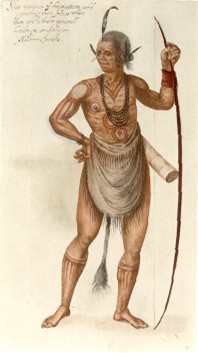
Figure 1. Watercolor by John White, Indian in Body Paint, ca. 1585 of a Carolina Algonquians, with a long bow as tall as himself, and quiver on the left hip.[22] Likewise, the dress, body paint, and the long bow that would have been typical of most Natives in the Southeastern regions of Northwest Florida, South and mid-South Alabama where the soldiers from the Luna Expedition would have been attacked by hostile Natives and received arrow wounds. Besides the bow being the instrument to “shoot” the arrow towards its mark, it is recorded in the Soto chronicles that the stout bow, itself, was used as a club to cockeye many a Spanish soldier when fighting in close range or even off a horse.
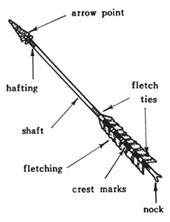
Figure 2. Parts of an arrow. (Not to scale)
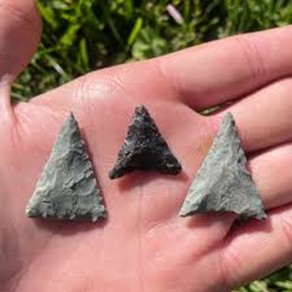
Figure 3. Depictions of Late-Mississippian arrow points or arrowheads to scale in a man’s hand,[23] which were much smaller and refined from earlier periods; and some points were even smaller, although the size of the point did not correlate with the size of the object to be killed. These points were also thinner and therefore lighter and razor sharp. This development allowed the arrow to fly faster and further as to bring down flying fowl, and pierce a target more deeply as in deer or bear, which tended to cause more bleeding and a quicker death. The points were commonly made from rocks like flint, chert, obsidian, jasper, and quartz in a process called “flintknapping.” A notch would be made in the shaft for the point to be placed, and then moist sinews of animals would be used to wrap around and fasten the point to the shaft. When the sinew dried, it would shrink and tightly secure the point with the shaft—secure enough to penetrate four layers of chain mail or piece through a deer.
The Native weapons were so impressive to the Spanish that the chroniclers of both the Soto and Luna Expeditions made the effort to give accounts and description of their power and deadly capabilities.
Concerning the Soto Expedition–as written by Garcilaso de la Vega, The Inca—here is a description of the bow and the strength it took to pull the string back:
The bows are of the same height as the men who carry them, and since the natives of Florida are generally tall, theirs are more than two yards in length and are thick in proportion. They make them of oak and of their other different woods which are strong and heavy. Thus, they are so difficult to bend that no Spaniard, regardless of how much he persisted, was able to draw a bowstring back as far as his face. Ther Indians on the other hand, because of their skill and constant use of the weapon, draw the cord with great ease, even to the back of the ear; and they make very fierce and frightful shots…The bow strings are made with thongs of deer skin. Taking a strip two fingers wide from the tip of the tail to the head of the deer, the Indians after first removing the hair, wet and twist this strip firmly. Tying one end to the branch of a tree, they suspend the other end a weight of one hundred or hundred and twenty-five pounds and leave it thus until it becomes like one of the heavy cords of the bass-viol and is very strong. In order to shoot with safety, so that the bowstring on being loosened may not injure the left arm, they trim that arm on the inner side with half bracer of heavy feathers, in this way protecting it from the wrist to the elbow. This bracer is secured with deer skin thong, which encircles the arm seven or eight times at the place where the bowstring quivers with the greatest force.[24]
Also, from Garcilaso–concerning an arrow shot by the Natives of the Apalache area of la Florida, which is around today’s Tallahassee:
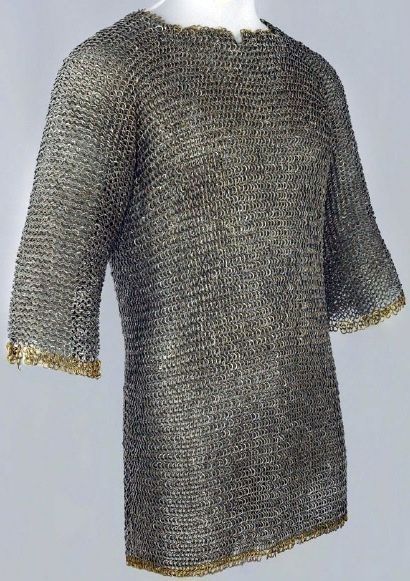
Thus, it was that in one of the skirmishes which the Spaniards had with the Indians of Apalache, the Camp Master Luis de Moscoso was struck in the right side by an arrow which penetrated a leather jacket and the hauberk (chain mail, Figure 4) which he wore underneath as well…The arrow had continued through a quilted doublet and wounded him, though not fatally since it came at a slant. The Spanish were amazed at such an unusual shot, and they wanted to now see just how much protection was actually afforded by these most highly polished [and expensive] coats of mail in which they had put so much confidence…they loosed from his chains one of the Indians of Apalache, and giving hm a bow and arrow, ordered him to shoot at the hauberk, which they had placed at a distance of fifty feet. Having shaken his arms with his fists clenched in order to awaken strength, the Indian released the arrow, and it penetrated both hauberk and [tightly woven] basket so freely and violently that it would have gone on through a man had there been one on the other side.[25]
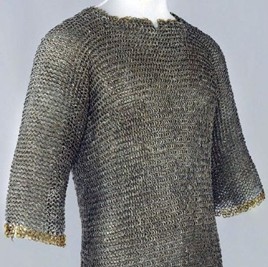
Figure 4. Depiction of a pull-over hauberk, which, was a protective shirt or tunic woven of chain mail.[26] Importantly, the waist-length versions did not protect a soldier’s thigh, which became evident and a prime target for Native arrows.
Garcilaso also wrote that further testing would have shown that a well-placed arrow could penetrate four layers of chain mail; and therefore, the Spanish soldiers began to develop cotton cloaks three or four fingers thick, with long folds that covered the chests and haunches of the horse.[27] He further wrote:
These cloaks, which were made of blankets, resisted arrows more effectively than any other of their defensive arms; and even those thick and quilted hauberks which they had held of no value, regardless of what protection they put beneath them, resisted arrows better than the very fine and highly burnished [metal] ones. The result was that those arms which had been scorned previously came to be esteemed, whereas those which had been valued were now [cast] aside.[28]
And as Garcilaso also notes, there are many more examples in the chronical of the power and piercing capabilities of the Native arrows, especially through armored horses.[29]
Likewise, in 1596 Dávila Padilla recorded in the chapters of his extensive Historia[30] descriptions from the Luna Expedition of the Native warriors of the chiefdom of Coosa and their bows and arrows. Below is an account of those warriors preparing for war with their enemies and former tributaries—the Napochies. It is believed that the seven little villages[31] of Coosa encountered by the Luna Expedition were located around today’s Weiss Lake area northeast of Gadsden, Alabama.[32]
The [Cocenses] gathered almost 300 very dexterous archers and very sure in the use of these weapons, since they were the only ones they used, they were very well exercised and proficient with them. Each Indian used a bow as high as his body,[33] the bowstring is not of hemp nor another thread, but of sinews of animals twisted and well cured. All of them use a quiver full of arrows of various thinness and very straight, whose point is of flint curiously worked in the shape of a triangle, with sharp fins, which they usually dip in some fatal poison. They also use in the arrows three or four feathers, so that they fly straight; and are so dexterous in sending them, that they can shoot down whatever they want to in flight: and the force of the flints is so much, that at a moderate distance they pass through a coat of mail with great ease….The Indians were well disposed, and better prepared to fight against their enemies, the Napochies, and they went carrying their bows, and arranging the arrows, so they slid from the bunch in the quiver with ease, preparing them so that it would quickly lend them new arrows, others required the collar which they carried the collected arrows that fell upon their backs; and all of them relaxed the arm, and grewstronger [setting] the feet into the soil, demonstrating in all so much desire for fighting, that they only displayed complaints about the delay.[34]
In Part 2 and Part 3 of this series, Spanish-Native confrontations will be discussed utilizing the storied lives of four Spanish soldiers who were either killed, wounded, or had their men wounded from a barrage of Native arrows, as well as some of the various supplications of rewards that were granted. Part 4 will address the apparent reasons why Viceroy Luis de Velasco in Mexico City and members of the Luna Expedition in la Florida omitted writing of the Native hostilities and arrow attacks.
References
[1] The text in many of the documents refer to the people asking for mercedes as “supplicants” and their “supplications.”
[2] For an account of the battle, See Narratives of the Hernando De Soto Conquest of Florida (account by the Gentleman of Elvas) translated by Buckingham Smith, Palmetto Books, Gainesville, Forida, 1968, 85-90, and a Relation, (an account by Luys Hernandez Biedma, secretary to Soto) 243-245; The Florida of the Inca (account of Garcilaso de la Vega) translated and edited by John Grier Varner and Jeannette Johnson Varner, University of Texas Press, Austin, 1951, 358-386.
[3] Agustín Dávila Padilla, Historia de la Fundación y Discurso de la Provincia de Santiago de México de la Orden de Predicadores por las vidas de sus varones insignes y casos notables de Nueva España, Brussles, 1625 ed., 208, informs that the Natives of the chiefdom of Coosa dipped their arrow tips into poison. See the quoted text below under the sub-section titled “The Native Bow and Arrow.”
[4]For various accounts of where Spanish soldiers were wounded or killed by Native arrows during the 1540 battle of Mauvila, See John Grier Varner and Jeannette Johnson Varner, translators and editors, The Florida of the Inca, 358-375, University of Texas Press, Austin, 1951.
[5] An encomienda was typically a royal grant of land that also included the labor and/or tribute of the Native population that lived there upon. Such tribute could be in the form of goods, labor, or other services.
[6] Because of his loyal and unselfish service on the Luna Expedition, Viceroy Luis de Velasco awarded Captain Baltasar de Sotelo an encomienda when he returned from la Florida to New Spain. See Manuel Orozco y Berra, Noticia histórica de la conjuracion del marques del Valle: Años de 1565-1568, 274, “XXX. If they know that after the said captain arrived to this land, always the said viceroy held him in esteem and to do courtesey and rewards[1] of to give an estate with incomes[1] and acres of land with to help sustain him, until [the viceroy] became sick and died. [He was given] the province of Mechoacan where he stayed without to leave of them until now, that he came to this city in the month of August on the 4th day. They said they know.” Translation by David B. Dodson.
[7] For one of the best and detailed compilations of the Council of Indies and with office holders’ names listed relevant to the Luna Expedition, See Ernesto Schafer, El Consejo Real Y Supremo De Las Indias, Tomo I, 1935; and for a continuation of the years after the Luna Expedition when the Council became on equal with all the other main councils in Spain, Tomo II, 1947 and 2003.
[8] During the reign of the Holy Roman Emperor and Spanish King Charles V many “nationalities” of his empire were allowed access to the New World; but under Philip II (who only became king of Spain) permission to travel to the New World Spanish empire was more regulated and strictly limited to only Spanish subjects who had to testify as to their Spanish heritage, which also included their Catholic faith. This “purity” of blood was intended to prevent Protestant or other “religious heretics” from tainting Spanish society as well as preclude spies from infiltrating the Spanish empire.
[9] See Part 2 of this series where the sale of items from the estate of Antón Guillén after being killed by a Native arrow in La Florida was processed by the House of Contratación, as recorded in AGI, Contratación 200, Número 2, Ramo 1, dated January 19, 1562.
[10] See John R. Fisher, “Casa de Contratación,” https://www.encyclopedia.com/humanities/encyclopedias-almanacs-transcripts-and-maps/casa-de-contratacion, excerpt from John R. Fisher, “Casa de Contratación” in Encyclopedia of Latin American History and Culture, vol. 1, p. 589. New York: Charles Scribner’s Sons, 1996.
[11] Although there is no record of a returning treasure fleet in 1562 to Spain, ships were still sailing in small groups before the “flota system” or protected convoy system was established by King Philip II in 1566 upon recommendation of Admiral Pedro Menéndez de Avilés—the founder of St. Augustine.
[12] Sargeant Francisco Benitez had his mercedes issued on January 18, 1563, See AGI. Mexico 2999, Libro 2, ff 178-179. The 1562 date is wrong and should read 1563 as other related January 18th documents related to the mercedes read.
[13] Up until around 1562-1563 when King Philip II put out an edict to make Spanish script in documents more readable, the notaries tended to write in a quick and fluid method that ran words together in an “artful” manner, but resembling Arabic script (i.e., hard to read!) One great translator—R. Wayne Childers–once commented to me that sometimes it would take a month of figuring the writing and lettering style of a notary before he could effectively read and translate a document with ease.
[14] AGI. Santo Domingo 11. Probonza, or Testimony of Ship’s Pilot Gonçalo Gayon,
Havana, Cuba, July 13, 1564. Most of this probonza has been translated by R. Wayne Childers, especially the parts that are applicable to la Florida.
[15] Libros y libreros en el siglo XVI, compiled by Francisco Fernández del Castillo, Archivo General De La Nación, Fondo De Cultura Ecómica, Mexico, 1982, 365. There is an entry concerning the flota that arrived to San Juan de Ulúa in September of 1573. It was incomplete and only listed one ship—the nao capitana La Trinadad. But it listed Francisco de Vargas as captain and maestre, and most interestingly, listed Gonçalo Gayon as the pilot.
[16] AGI. Contaduria 877, March 8, 1554. Amançebado… cohabiting with a concubine.
[17] The documents at hand do not indicate the “de Zayas” part of the name, but that he had a son with him on the expedition as well as with him in Spain in 1562—along with other soldiers seeking mercedes— gives some evidence that the two might be one in the same.
[18] Priestley, I, 127, Velasco To Luna, Mexico City, May 6, 1560.
[19] AGI. Justicia,862,N.5, found at ES.41091.AGI/23//JUSTICIA,862,N.5 dates of 1563-02-26 –1563-03-05.
[20] negro esclavo…black slave. AGI. Justicia,862,N.5, found at ES.41091.AGI/23//JUSTICIA,862,N.5. verso 5 or page 10.
[21] AGI. Justicia,862,N.5, found at ES.41091.AGI/23//JUSTICIA,862,N.5 , 1563-02-26 –1563-03-05.
[22] https://americainclass.org/wp-content/uploads/2011/06/white_47.jpg
[23] https://encrypted-tbn0.gstatic.com/images?q=tbn:ANd9GcTuF0v3WjirWBpJlL2caFJK3XVERVhLlVtqFA&s
[24] John Grier Varner and Jeannette Johnson Varner, translators and editors The Florida of The Inca, 17, The University of Texas Press, Austin, 1951.
[25] John Grier Varner and Jeannette Johnson Varner, translators and editors The Florida of The Inca, 234-236, The University of Texas Press, Austin, 1951.
[26] https://great-castles.com/photos/weapons/chainmail.jpg
[27] John Grier Varner and Jeannette Johnson Varner, translators and editors The Florida of The Inca.
[28] Ibid.
[29] Ibid., 60, 147.
[30] Agustín Dávila Padilla, Historia de la Fundación y Discurso de la Provincia de Santiago de México de la Orden de Predicadores por las vidas de sus varones insignes y casos notables de Nueva España, Brussles, 1596, and Madrid 1625.
[31] Dávila Padilla, Historia, 1625 ed., 205.5, “There were seven little settlements (pueblezuelos) in its territory, five that were smaller than Coosa, and two that were larger; although the name of Coosa, always prevailed, by this name and the others that in its history having had.” Translation by R. Wayne Childers and David B. Dodson.
[32] Keith J. Little, EUROPEAN ARTIFACT CHRONOLOGY AND IMPACTS OF SPANISH CONTACT IN THE SIXTEENTH-CENTURY COOSA VALLEY, a Dissertation, The University of Alabama, Tuscaloosa, Alabama, 2008, Chapter 14, 227.
[33] Archeologists—through burial excavations when it was still allowed–determined that the Natives were taller than the average Spaniard, and therefore give the Natives a height of around 5 foot six inches tall.
[34] Agustín Dávila Padilla, Historia, 1625, ed., 208. Translation by R. Wayne Childers and David B. Dodson.