Download .pdf of this article here.
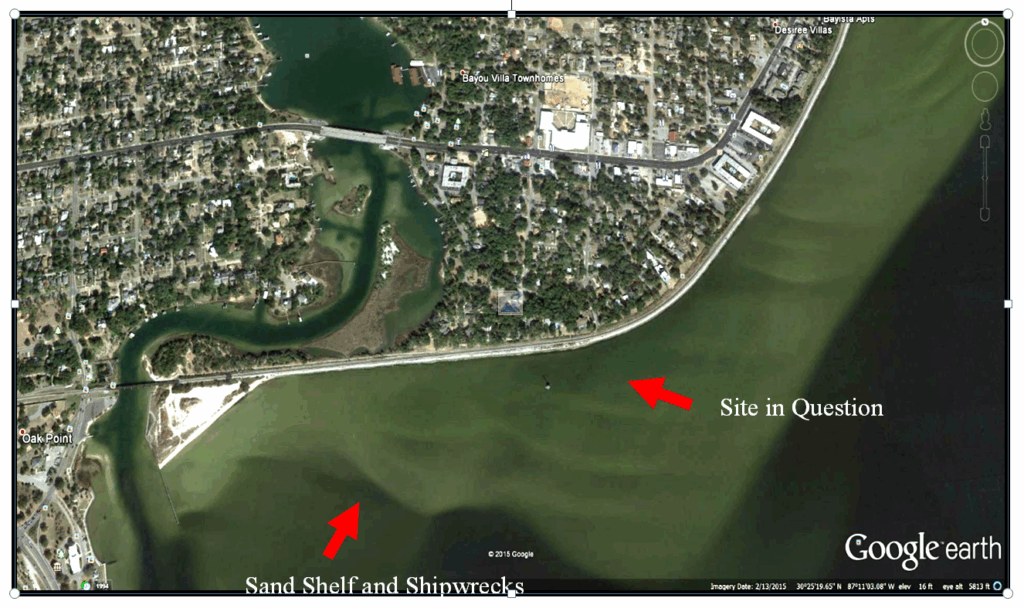
There is a very important archeological site on the shore of Pensacola Bay. It was the first officially recorded archeological site in Escambia County, Florida which speaks to its’ importance. It is known as The East Pensacola Site, officially recorded with the Florida Master File as 8Es1. This article presents the history of archeological research at the site. It begins with the research in the late 1800s and continues with the research in the 1940s through 2025. The article concludes with the site evaluations of the Contact Archeology Inc. Research and Education Group.
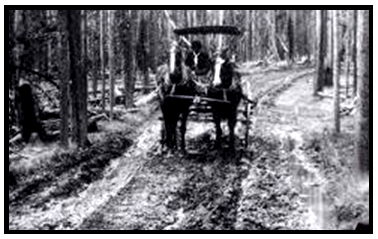
Horse/buggy/dirt road of the period.
The Smithsonian Institution (1885):
The Smithsonian’s representative, S.T. Walker, conducted a survey of Pensacola Bay recording mound sites. His map proved to be accurate in later years. He illustrated two mounds at the East Pensacola Heights Native village site (Walker 1885:pg.855). We do not know how Walker traveled to conduct his field investigations. The methods at that time were by river, rail, and horse power.
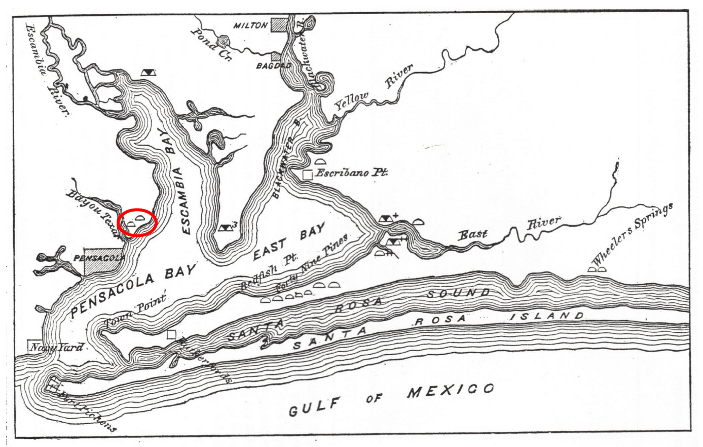
Native East Pensacola Heights Site burial mounds (8Es1) recorded by the Smithsonian Institution in 1885 (Walker 1885). Burial mounds are differentiated from pyramidal mounds by different symbols on the map. Burial mounds are depicted as half circles and pyramidal mounds are shown as flat topped pyramid shapes.
Columbia University / National Park Service Survey (1940):
Fifty-five years later another survey was led by Gordon R. Willey, a staff member of the Bureau of American Ethnology at the Smithsonian Institution. Presumably, the mounds found earlier by the Smithsonian had been destroyed by the residential expansion of area or the vegetation was too dense to find them: The inland extent of the site could not be determined because of the vegetation (Willey 1949:pg. 200).
The survey did find Mississippian and Woodland Period ceramic sherds eroding from the bay shore bank. A black midden was also observed 10-30 centimeters below the surface midden extending some 200 meters along the shoreline. The inland extent of the site could not be determined because of the dense vegetation
present.
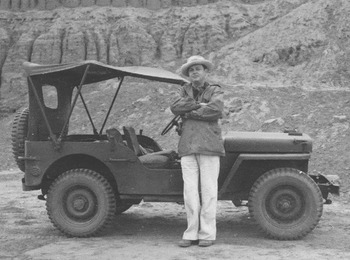
Gordon R. Willey with his Jeep
Early Pioneer of Florida Gulf Coast Archeology for the Smithsonian Institution, Willey investigated the East Pensacola Heights Site in the 1940’s and recorded the importance of the Native occupation.
University of West Florida (1986-87):
Forty-six years later the site was revisited by the University of West Florida (UWF) during a survey of portions of the City of Pensacola. (Bense et al. 1987, 1989). It was determined by UWF that the site was a large village complex dating to the Mississippian and Woodland Periods at which the Smithsonian Institution reported two mounds. UWF also reported that the site is buried by 10-20 centimeters (4-8 inches) of sterile sand. The midden is 10-50 centimeters thick and contains marine shell remains as well as Native pottery, mostly dating to the Mississippian Period. UWF also concluded that the large Mississippian Period Native occupation at the site covered approximately 25 acres and that 78% of the ceramic sherds were shell tempered, indicating a consistent Mississippian Period Native population over time.
Also during this time period personnel from UWF and the Pensacola Archeological Society made contact with the property owner of a portion of the site, Calvin Todd, who had been digging for Native pottery on his property. Numerous sherds of decorated Mississippian pottery and effigies were found that appear to be funerary objects, possibly from one of the two burial mounds reported previously by the Smithsonian Institution.
Allegedly, part or all of the Todd collection is housed at UWF (personal communication, Calvin Todd, Estate Administrator Robert Hurst, Pensacola Archaeological Society, and Historian David Dodson). CAI was not able to locate any documents related to the excavations at the Todd property.
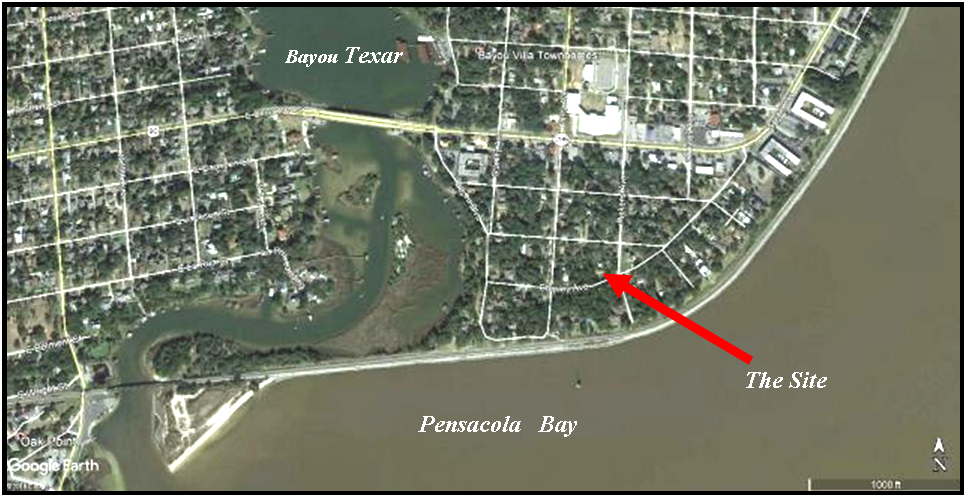
East Pensacola Heights Location Map
Contact Archeology Inc. (CAI) (1990s – 2012):
Four years (1991) after the UWF city survey members of the current Contact Archeology Inc. (CAI) research group focused our attention on the location of the Luna Colony on Pensacola Bay. The East Pensacola Heights Site was one of our focuses. Numerous trips were made to the site by the CAI team primarily to make surface collections from the shoreline during the 1990s (Curren 1994). A CAI research team also conducted a Cultural Resource Assessment survey of a portion of the site in 2012 prior to the Hurst residential development (Curren 2012). The determinations of the research group was that the prior investigations of the site size, midden depth, and archeological time periods were correct. The site was primarily a large late Woodland and Mississippian Period village and perhaps a Creek settlement.
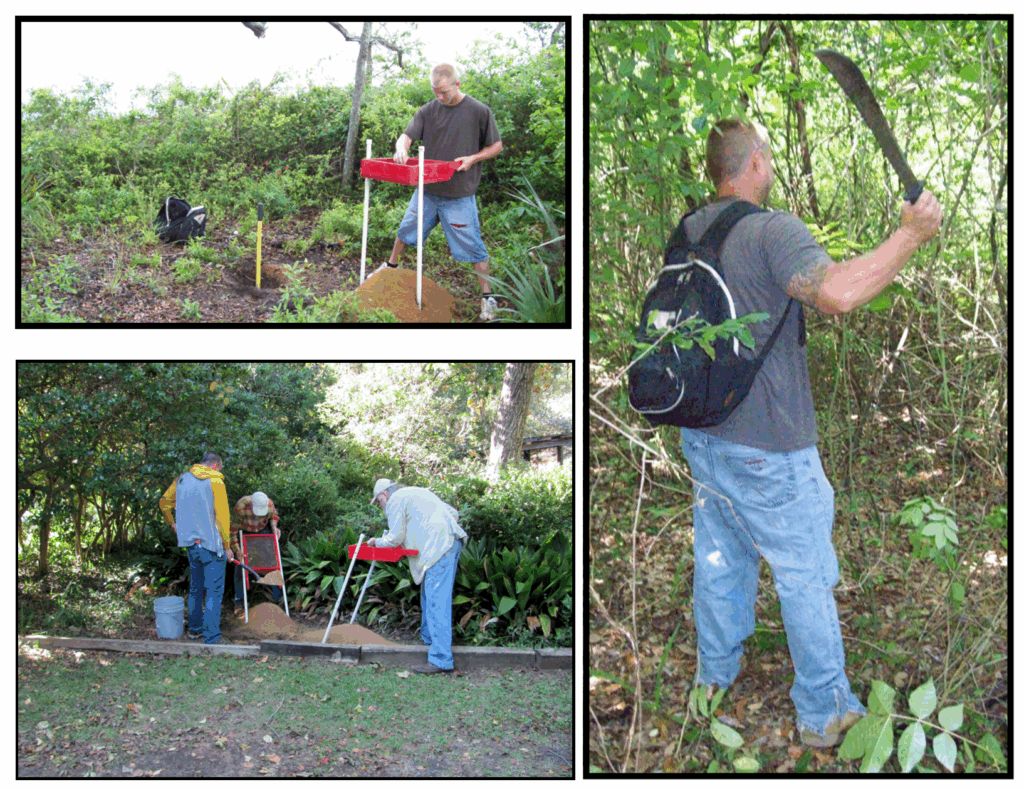
Contact Archeology Inc. at the East Pensacola Heights Site (8Es1).
Discovery of a Luna Expedition Shipwreck by the Florida BAR Research, 1992
The 1992 discovery by the Florida State Bureau of Archeological Research (BAR) of a shipwreck from the Luna Expedition brought up a new aspect concerning the site (Smith et al. 1995,1998). Might the Tristan de Luna Spanish Settlement of 1559 be located at the East Pensacola Heights Site?
At first glance this seems to be evidence that the Native site adjacent to the shipwreck is the location of the Luna Settlement, however, as the BAR discoverers of the shipwreck noted, this is not the case. The BAR authors stated that the shipwreck was found in shallow water on a sand bar that provided poor anchorage as well as an unprotected anchorage for ships of any size. The shipwreck was not anchored on the sand bar, neither were the other two shipwrecks found on the sand bar later by the University of West Florida. The ships were apparently driven upon the sandbar by wind and water during the 1559 hurricane from their anchorage somewhere else in Pensacola Bay, therefore, the shipwrecks cannot, legitimately, be used as proof of the Luna Colony location.
“The ship had grounded violently during a severe storm on a shallow bar” (Smith 2009:pg. 79).
“The wind blew … for twenty-four hours, snapping the moorings of the ships … there came up from the north a fierce tempest, which, blowing for twenty-four hours from all directions … did irreparable damage to the ships of the fleet … all the ships which were in this port went aground”
(Priestley 1928: Vol. II, pg. 245).
“… the most terrible storm and the wildest norther that men have ever seen (struck the fleet). As if the cable(s) were string and the anchors were not iron … “ (Padilla 1596).
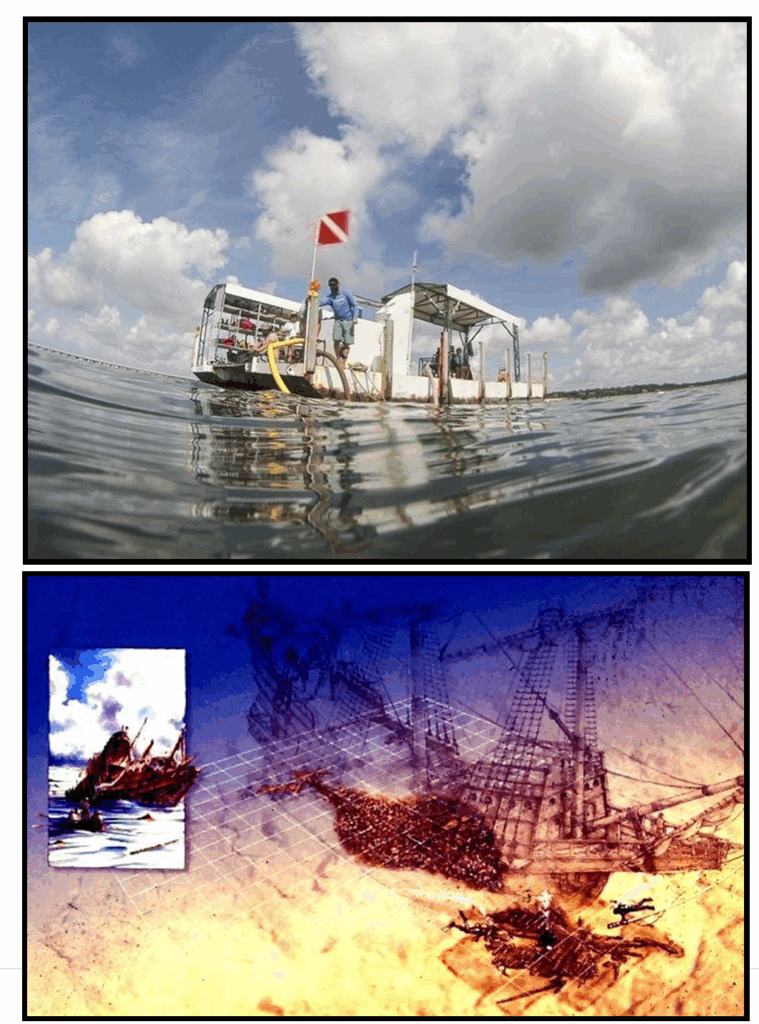
Shipwreck Investigations
University of West Florida (2015-25):
In 2015, 19 years later, a local man found a sample of Spanish artifacts dating to the 1500s on a residential construction site on the East Pensacola Heights Site. He took his finds to UWF and within a very short period of time UWF proclaimed that they had definitely found the Luna Settlement Site. They then went to the media with their claim. UWF is still claiming that the site is the Luna Settlement Site despite a significant lack of definitive archeological data to support their claim. UWF has certainly found more Spanish artifacts dating from the 1500s but they were found with a majority of Native artifacts. Once again, it confirms previous investigations that the site is a Native village that had contacts with various Spanish incursions into the area during the 1500s. UWF has thus far failed to prove that the site is the actual Luna Expedition Spanish settlement.
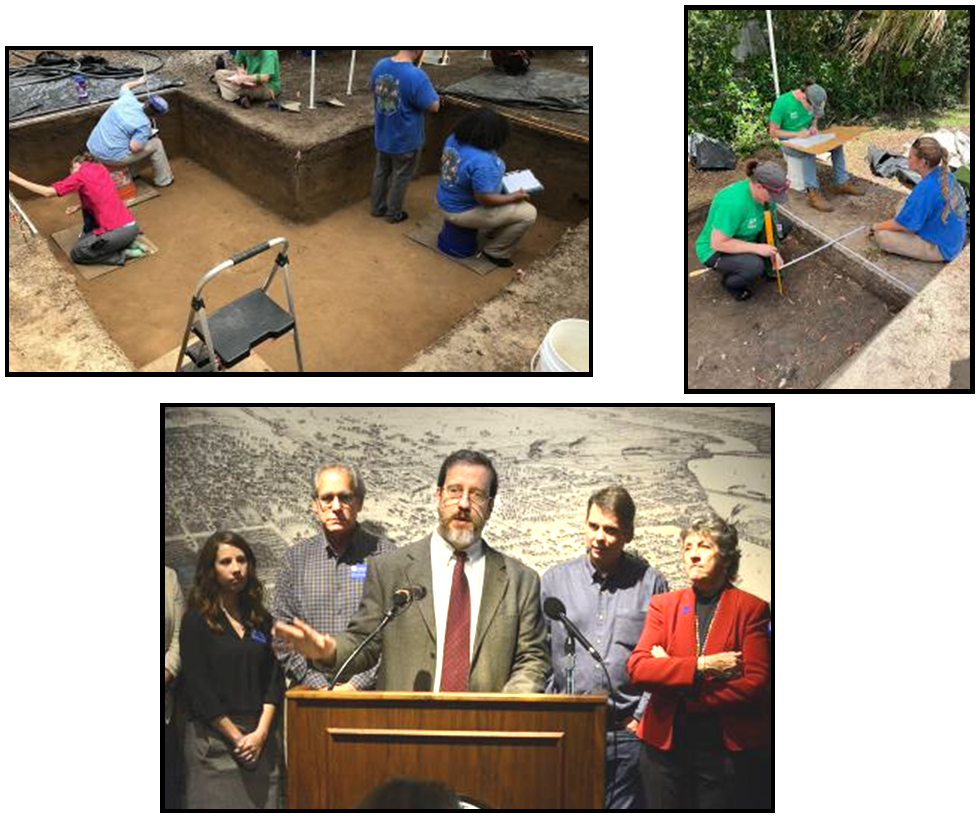
Above: UWF Students Laboring in the Summer Heat of Pensacola.
Below: UWF Leaders Prematurely Claiming the Luna Colony.
The Ten Year UWF Excavations at their Alleged Luna Colony Site:
The University of West Florida (UWF) has excavated an incredible portion of site 8Es1 but after ten years of excavations UWF has not found the necessary features to prove that the site is the Luna Colony (Worth 2019). Numerous Spanish burials, fire hearths, refuse pits, or structures have not been found. The Spanish artifacts they have found are mixed with Native artifacts, reinforcing the fact that the Natives had contact with various Spanish expeditions of the 1500s but the Spanish people of the Luna very likely did not live there.
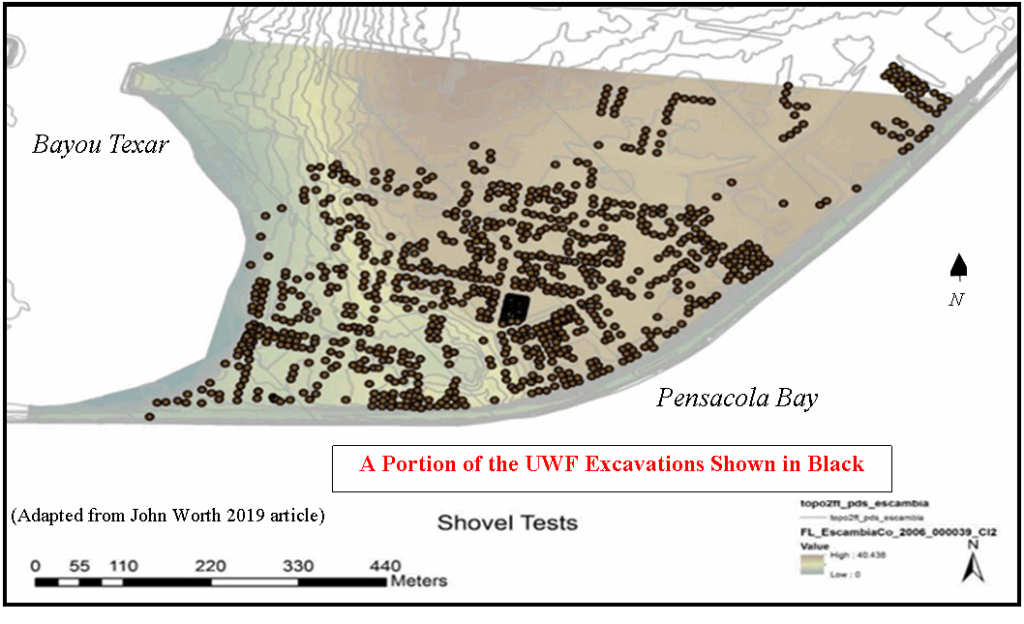
Showing a portion of the UWF excavations
Site Evaluation by Contact Archeology Inc. Research Group
The East Pensacola Heights Site (8Es1) on Pensacola Bay is a very important archeological site. It has definitely been proven by several research groups over the past 140 years to be a large prehistoric and historic Native village with over 70% of the ceramic remains proving to be from the Mississippian Period as well as the presence of two burial mounds.
The University of West Florida (UWF) has deliberately downplayed this fact since finding Spanish artifacts at the site dating from the 1500s, claiming that the site is the Luna Colony site. In doing so, they have put their credibility in jeopardy. The Spanish documents of the Luna Expedition never mentioned a Native village at their colony site. Remarkably, UWF has attempted to explain away the Mississippian pottery as brought to the site by interior Spanish expeditions into Alabama.
It is curious that UWF has contradicted its own conclusions concerning the occupation of the site. During their own excavations in the 1980s they acknowledged the Smithsonian discovery of two burial mounds on the site and that the midden on the site was primarily deposited during the Mississippian Period (Bense et al. —-).
UWF has certainly found more Spanish artifacts from the site but they apparently jumped to the conclusion that they definitely represented the Luna Settlement without the proper subsurface features to prove it.
UWF has used the three 16th-Century shipwrecks found by the state offshore from the terrestrial site as proof of the Luna Settlement. In truth, the shipwrecks were not anchored and could have come from anywhere on Pensacola Bay at their original anchorage adjacent to the Luna Colony.
Thus, for now, the hard data from the East Pensacola Heights Site indicates that the 25 acre site is a Mississippian Native village whose people traded with one or more Spanish expeditions and/or salvaged artifacts from the Spanish shipwrecks offshore from their village.
We at CAI look forward to reviewing the technical report of the ten years of UWF excavations at the site.
Related Research Documents
Bense, Judith A. (et al.)
1887 Report of the Pensacola Archaeology Survey1986 Season. University of West Florida Office of Cultural and Archaeological Research. Report of Investigations No. 10.
1989 The Pensacola Archaeological Survey. The Pensacola Archaeological Society Publication No. 2.
Curren, Caleb
1994 The Search for Santa Maria, a 1559 Spanish Colony on the Northern Florida Coast. Pensacola Archeology Lab. Pensacola, Florida.
2012 A Phase I Cultural Resource Survey of the Proposed Emanuel Point Development, Escambia County, Florida. Contact Archeology Inc. (CAI). Pensacola, Florida.
Padilla, Augustin Davila
1596 Historia, 1596 ed.
Priestly, Herbert Ingram
1928 The Luna Papers. Two volumes. Florida State Historical Society. Deland, Florida.
Smith, Roger C., James Spirek, John Bratten, Della Scott-Ireton
1995 The Emanuel Point Ship: Archaeological Investigations, 1992-1995. Bureau of Archaeological Research, Division of Historical Resources, Florida Department of State.
Smith, Roger C., John Bratten, J. Cozzi, and Keith Plashett
1998 The Emanuel Point Ship Archaeological Investigations, 1997-1998. Bureau of Archaeological Research, Division of Historical Resources, Florida Department of State.
Walker, S.T.
1885 Mounds and Shell Heaps on the West Coast of Florida. Annual Report of the Smithsonian Institution for 1883, pgs. 854-868. Washington D.C.
Willey, Gordon R.
1949 Archeology of the Florida Gulf Coast. Smithsonian Institution. Washington D.C.
Worth, John E.
2019 The Luna Settlement in Archaeological and Documentary Perspective. Paper presented at the 37th Annual Gulf Coast South History and Humanities Conference. Pensacola, Florida.